
- Home
- Stainless steel
- SS 304 / 304L / 304H
SS 304 / 304L / 304H
SS 304 / 304L / 304H: Specifications | Grades & Standards | Product Types | Equivalent | Chemical | Mechanical | BW Fittings | Forged Fittings | Flanges | FAQ
Manufacturers & Suppliers of SS 304 Pipe Fittings, 304L Flanges, SS 304H Forged Fittings, SS 304 Buttweld Elbows, Tees, Reducers, UNS S30400/S30403 Pipe Fittings & Flanges – ASTM A182 / A403 Certified, Corrosion-Resistant, High-Temperature Piping Solutions Exported to USA, Europe, Middle East, Africa, India & Asia.
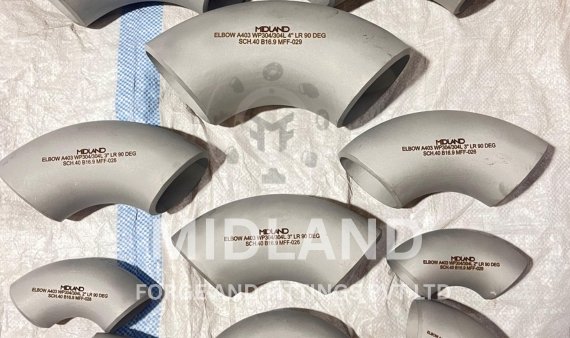
Best Export Prices: sales@midlandforgefittings.com
Midland Forge and Fittings Pvt. Ltd. is a leading manufacturer, supplier, and exporter of high-quality stainless steel fittings and flanges. With a robust infrastructure and state-of-the-art manufacturing facilities, we specialize in producing Buttweld, Socket Weld, Threaded Fittings & Flanges that meet global standards, including ASTM, ASME, and MSS certifications.
Our operations are supported by a skilled workforce, advanced quality control laboratories, and an integrated supply chain that ensures timely delivery, precision engineering, and consistent product excellence. From procurement of raw materials to final inspection, every stage of production is meticulously monitored to maintain the highest standards of performance and reliability.
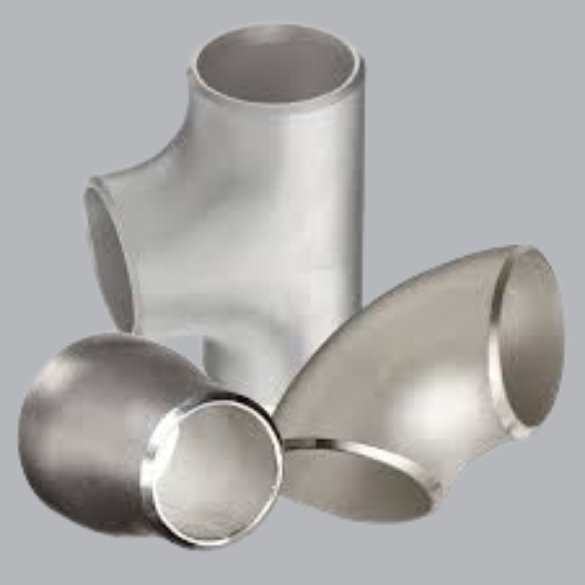
Stainless Steel 304, 304L, and 304H buttweld fittings are precision-engineered components designed for seamless integration into piping systems. Manufactured according to ASTM A403 standards, these fittings offer excellent corrosion resistance, high tensile strength, and durability across a wide range of industrial applications. The low-carbon variant 304L minimizes carbide precipitation during welding, making it ideal for chemical and petrochemical industries, whereas 304H provides enhanced tensile strength for high-temperature applications. Available in elbows, tees, reducers, and end caps, these fittings ensure smooth flow, minimal pressure drop, and leak-proof connections in pipelines.
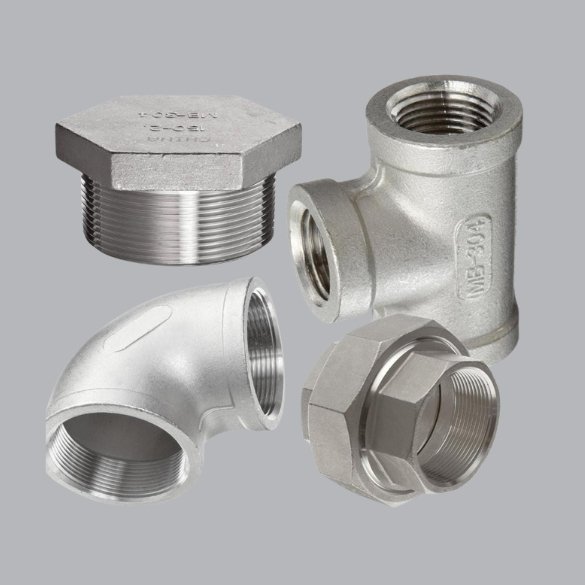
Forged Fittings in SS 304, 304L, and 304H are manufactured using high-pressure forging techniques that enhance mechanical strength, impact resistance, and fatigue endurance. Conforming to ASTM A182 standards, these fittings are suitable for high-pressure, high-temperature, and critical piping applications in oil & gas, power plants, and marine industries. Forged fittings include components such as tees, elbows, couplings, and reducers, providing tight tolerances, uniform wall thickness, and superior dimensional accuracy. Their robust construction ensures long-term performance even under demanding operational conditions.
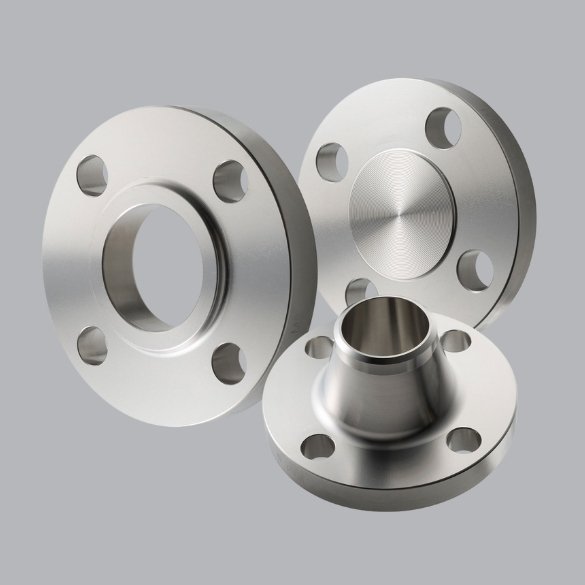
Stainless Steel 304, 304L, and 304H flanges are precision-fabricated to provide secure, leak-proof connections between pipes, valves, and other equipment. Available in weld neck, slip-on, socket weld, threaded, and blind types, these flanges conform to ASME B16.5 / B16.47 / ASTM A182 standards. They offer excellent corrosion resistance, high tensile strength, and thermal stability, making them ideal for chemical, petrochemical, pharmaceutical, and food processing industries. Machined to tight dimensional tolerances, these flanges ensure easy alignment, proper gasket seating, and long-lasting service life in high-pressure and high-temperature environments.
Our vision is to be recognized as a global leader in the piping industry, delivering durable and innovative solutions that exceed client expectations. Our mission is to provide high-performance fittings and flanges that combine superior quality, corrosion resistance, and reliability for industries including oil & gas, chemical, petrochemical, marine, and food processing. We are committed to sustainable practices, technological advancement, and continuous improvement, ensuring long-term value for our customers and stakeholders. Driven by integrity, precision, and customer-centricity, we strive to build lasting partnerships and uphold our reputation as a trusted supplier in the global market.
SS 304/304L/304h Specifications
Size Range – (Buttweld, Forged, Flange)
Pressure Rating/ Wall Thickness
Applications
ASTM / ASME
ASTM/ASME A403/SA403
Grades, EN, UNS
304L - S30403, X2CrNi18-9,
304H - S30409, X6CrNi18-10
Quality Certifications
Dimensional Standards
Forms
Surface Finish
Stainles Steel 304/304L/304H – Grades & Standards
| Grade | Buttweld Fittings Standards | Forged Fittings Standards | Flanges Standards |
|---|---|---|---|
| 304 | ASTM A403 / ASME B16.9 / MSS-SP-43 | ASTM A182 / ASME B16.11 | ASTM A182 / ASME B16.5 / B16.47 |
| 304L | ASTM A403 / ASME B16.9 / MSS-SP-43 | ASTM A182 / ASME B16.11 | ASTM A182 / ASME B16.5 / B16.47 |
| 304H | ASTM A403 / ASME B16.9 / MSS-SP-43 | ASTM A182 / ASME B16.11 | ASTM A182 / ASME B16.5 / B16.47 |
Stainless Steel 304 / 304L / 304H Industrial Products
ASTM A182 SS 304 Threaded Fittings - Equivalent Grades
| Grade | UNS | ASTM | EN (DIN) | JIS | GOST | BS | AFNOR |
|---|---|---|---|---|---|---|---|
| 304 | S30400 | A240 / A276 | 1.4301 (X5CrNi18-10) | SUS304 | 08Х18Н10 (08X18H10) | 304S15 | Z6CN18-09 |
| 304L | S30403 | A240 / A276 | 1.4306 (X2CrNi18-9) | SUS304L | 03Х18Н11 (03X18H11) | 304S12 | Z2CN18-10 |
| 304H | S30409 | A240 / A276 | 1.4948 (X6CrNi18-10) | SUS304H | 08Х18Н10М (08X18H10M) | 304S18 | Z6CN18-12 |
SS ASTM A403 304L Pipe Fittings - Chemical Composition
| Grade | C (%) | Cr (%) | Ni (%) | Mo (%) | Mn (%) | Si (%) | P (%) | S (%) | N (%) | Others |
|---|---|---|---|---|---|---|---|---|---|---|
| 304 | ≤ 0.08 | 18.0 – 20.0 | 8.0 – 10.5 | – | ≤ 2.00 | ≤ 0.75 | ≤ 0.045 | ≤ 0.03 | – | – |
| 304L | ≤ 0.03 | 18.0 – 20.0 | 8.0 – 12.0 | – | ≤ 2.00 | ≤ 0.75 | ≤ 0.045 | ≤ 0.03 | – | – |
| 304H | 0.04 – 0.10 | 18.0 – 20.0 | 9.0 – 12.0 | – | ≤ 2.00 | ≤ 0.75 | ≤ 0.045 | ≤ 0.03 | – | – |
ASME SA182 SS 304h Flanges - Mechanical Properties
| Grade | Tensile Strength (MPa) | Yield Strength (MPa) | Elongation (%) | Hardness (HB) | Hardness (HRB) | Hardness (HRC) |
|---|---|---|---|---|---|---|
| 304 | 515 – 750 | ≥ 205 | ≥ 40 | ≤ 201 | ≤ 92 | ≤ 22 |
| 304L | 485 – 700 | ≥ 170 | ≥ 40 | ≤ 183 | ≤ 88 | ≤ 20 |
| 304H | 515 – 750 | ≥ 205 | ≥ 40 | ≤ 201 | ≤ 92 | ≤ 22 |
Stainless Steel 304 / 304L / 304H Buttweld Fittings – Seamless, Welded & Fabricated Types
Types of Stainless Steel 304/304L/304h Flanges for Piping Systems
Stainless Steel 304/304L/304H Forged Fittings – Complete Guide
What is Stainless Steel 304, 304L, and 304H?
Stainless Steel 304:
Most widely used austenitic stainless steel grade.
Contains 18–20% chromium (Cr) and 8–10.5% nickel (Ni).
Excellent corrosion resistance, durability, and formability.
Suitable for a wide range of industrial applications.
Stainless Steel 304L:
Low carbon variant of SS 304 (≤ 0.03% C).
Designed to minimize carbide precipitation during welding.
Ideal for welded structures where post-weld corrosion resistance is critical.
Stainless Steel 304H:
High carbon variant of SS 304 (≥ 0.04% C).
Offers higher tensile and yield strength at elevated temperatures.
Commonly used in pressure vessels and high-temperature applications.
What are the key advantages of SS 304/304L/304H pipe fittings and flanges?
1. Corrosion Resistance
Stainless Steel 304 series exhibits excellent resistance to corrosion in oxidizing environments such as air, water, and many chemicals.
The chromium content (18–20%) forms a thin, passive oxide layer on the surface that prevents rust and deterioration.
It also resists mildly reducing environments, including diluted acids and alkaline solutions, making it suitable for industrial and marine applications.
304L, with its lower carbon content, minimizes carbide precipitation during welding, preventing localized corrosion (sensitization).
304H, while high in carbon, maintains corrosion resistance at elevated temperatures.
2. Durability
These stainless steel grades offer high tensile strength and toughness, ensuring reliable performance under mechanical stress.
They are resistant to wear, abrasion, and impact, making them ideal for pipelines and pressure systems that undergo frequent handling or vibration.
Long service life is assured even in harsh industrial environments such as chemical plants, oil & gas, or marine pipelines.
Minimal maintenance is required compared to carbon steel, reducing long-term operational costs.
3. Temperature Resistance
SS 304 series can withstand both low (cryogenic) and high-temperature conditions without significant loss of strength or ductility.
304H, with its higher carbon content, is particularly suitable for elevated temperature applications such as boilers, heat exchangers, and pressure vessels, where 304 and 304L may not meet the required strength.
These materials maintain structural integrity and resist oxidation even at temperatures up to 870°C in continuous service.
4. Hygienic and Easy to Clean
The smooth, non-porous surface of SS 304/304L/304H prevents accumulation of dirt, bacteria, and other microorganisms.
This makes them ideal for food processing, pharmaceutical, and water treatment applications, where hygiene is critical.
Routine cleaning is simple, using mild detergents or approved chemical cleaners without damaging the surface.
Unlike ordinary steels, these grades do not require protective coatings, ensuring long-lasting cleanliness and safety.
5. Fabrication Friendly
These stainless steels are highly workable, allowing for bending, forming, and machining into various fittings and flanges.
Welding is straightforward, especially with 304L, which avoids carbide precipitation and reduces the risk of intergranular corrosion.
They can also be easily polished or finished to meet aesthetic or sanitary requirements.
This versatility ensures that components can be manufactured to precise dimensions for complex piping systems without compromising strength or corrosion resistance.
How to select between 304, 304L, and 304H for a project?
1. Stainless Steel 304 – General-Purpose Applications
Use Case: Ideal for standard piping systems and fittings exposed to moderate corrosion.
Reason: It offers excellent corrosion resistance, durability, and ease of fabrication.
Applications: Water pipelines, HVAC systems, food and beverage processing, and general industrial piping.
Advantages: Readily available, cost-effective, and suitable for most environments where high-temperature strength is not critical.
2. Stainless Steel 304L – Extensive Welding or Thin Sections
Use Case: Preferred when welding is extensive or for thin-walled sections of piping and flanges.
Reason: The low carbon content (≤ 0.03%) reduces carbide precipitation during welding, minimizing the risk of intergranular corrosion.
Applications: Welded pressure vessels, chemical tanks, pipelines requiring frequent welding, and complex fabricated systems.
Advantages: Excellent corrosion resistance after welding, better for delicate or thin components, and maintains strength over welded joints.
3. Stainless Steel 304H – High-Temperature or High-Stress Applications
Use Case: Selected for elevated temperature service or high-stress piping systems.
Reason: The high carbon content (≥ 0.04%) increases tensile and yield strength, ensuring reliable performance at higher temperatures.
Applications: Boiler tubing, heat exchangers, power plants, petrochemical piping, and pressure vessels operating at elevated temperatures.
Advantages: Maintains mechanical strength under heat, suitable for high-pressure and high-temperature industrial processes, and resists deformation.