
- Home
- Carbon Steel
Carbon Steel
Carbon Steel: Specifications | Grades & Standards | Product Types | Equivalent Grades | Chemical Composition | Mechanical Properties | BW Fittings | Forged Fittings | Flanges | FAQ
Trusted Manufacturer, Supplier & Exporter of Carbon Steel Pipe Fittings, Forged Fittings & Flanges including Elbows, Tees, Reducers, Crosses, Caps, Slip-On Flanges, Weld Neck Flanges, Blind Flanges, Threaded Flanges & Orifice Flanges in ASTM A105, A234 WPB, A350 Grades, Supplying to the USA, Germany, Italy, Saudi Arabia, UAE, Qatar, Oman, Kuwait, Singapore & Malaysia.
Best Export Prices: sales@midlandforgefittings.com
Midland Forge and Fittings Pvt. Ltd. is a trusted manufacturer and exporter of carbon steel pipe fittings, forged fittings, and flanges engineered for high-performance industrial applications. Manufactured in compliance with ASTM A105, A234 WPB, A350 LF2, and A694 F42–F70 standards, these products are designed to deliver exceptional strength, pressure resistance, and durability.
With a strong commitment to quality and innovation, the company provides reliable piping solutions. Every product undergoes stringent testing and inspection to ensure superior performance under extreme service conditions. Supported by a robust global supply network, these carbon steel fittings and flanges are widely supplied to the USA, Germany, Italy, Saudi Arabia, and Malaysia, meeting the diverse needs of international clients with consistent precision and reliability.
Carbon steel buttweld and forged fittings are manufactured from ASTM A105, A234 WPB, A350 LF2, and A694 F42–F70 grades, providing exceptional tensile and yield strength. These components are precision-forged and heat-treated to ensure uniform wall thickness, dimensional accuracy, and superior pressure handling for high-temperature piping systems.
The product range includes elbows, tees, reducers, crosses, caps, stub ends, slip-on flanges, weld neck flanges, blind flanges, and orifice flanges, designed in compliance with ASME B16.9, B16.5, B16.11, and DIN/EN standards. Each fitting ensures reliable, leak-proof joints suitable for critical industrial applications.
These carbon steel fittings and flanges are ideal for oil & gas, petrochemical, power generation, and offshore industries, where high mechanical strength, corrosion resistance, and long-term durability are essential. Advanced inspection and testing procedures guarantee consistent performance under extreme operating conditions.
Carbon steel Pipe Fittings Specifications
Size Range – (Buttweld, Forged, Flange)
Pressure Rating/ Wall Thickness
Applications
ASTM / ASME - Grades
A105, A106, A516 Gr.70, A350 LF2,
.A694 F42 / F52 / F60 / F65
Types
Quality Certifications
Dimensional Standards
Forms
Surface Finish
Carbon Steel Threaded Fittings– Grades & Standards
| Carbon Steel Grade | UNS No. | Applicable Standards | Typical Products |
|---|---|---|---|
| ASTM A105 | K02500 | ASTM A105, ASME B16.11, B16.5, MSS-SP-83 | Threaded Fittings, Forged Fittings, Flanges |
| ASTM A234 WPB | K02600 | ASTM A234, ASME B16.9, B16.11 | Buttweld Fittings, Elbows, Tees, Reducers |
| ASTM A350 LF2 | K03001 | ASTM A350, ASME B16.11, B16.5 | Threaded & Forged Fittings, Flanges |
| ASTM A694 F42 / F46 / F52 / F60 / F65 / F70 | K03001 – K03006 | ASTM A694, ASME B16.11, B16.5 | High-strength Flanges & Fittings |
| ASTM A182 F11 / F22 | K21590 / K21595 | ASTM A182, ASME B16.5, B16.11 | Forged Fittings, Flanges, Elbows |
| ASTM A182 F5 / F9 | K21550 / K21560 | ASTM A182, ASME B16.5, B16.11 | Forged Fittings, Flanges |
Explore Carbon Steel
Request for an Immediate Offer?
We will reply you in 2 hours during support time!
Conctact Now!Explore All Products
Carbon Steel Products
Carbon Steel Buttweld Fittings Equivalent Grades – ASTM, ASME, DIN, JIS & UNS
| ASTM / ASME | EN / DIN | JIS | GOST / Russia | BS / UK |
|---|---|---|---|---|
| A105 | C22 / 1.0460 | S25C | 20 | 080M40 |
| A105N / A105WN | 1.0460 | S25C | 20 | 080M40 |
| A350 LF2 | P250GH / 1.0562 | STB50 | 15 | 080 |
| A350 LF3 | P280GH / 1.0567 | STB50 | 20 | 080 |
| A106 Gr. B | 1.0330 / P265GH | STB42 | 17G1S | 152 |
| A53 Gr. B | 1.0038 / C22.8 | STB42 | 20 | 120 |
| A234 WPB | 1.0330 / P265GH | STB42 | 17G1S | 152 |
| A234 WPC / WPL6 | P235GH / 1.0345 | STB42 | 17G1S | 152 |
| A516 Gr. 60 | 1.0570 / P235GH | STB42 | 17G1S | 152 |
| A516 Gr. 70 | 1.0570 / P265GH | STB42 | 17G1S | 152 |
| A283 Gr. C | C22.8 / 1.0345 | STB42 | 20 | 080 |
| A204 Gr. B | P265GH / 1.0330 | STB42 | 15 | 080 |
| A182 F1 / F2 | 1.0460 / C22.8 | S25C | 20 | 080M40 |
| A182 F11 / F22 | 13CrMo4-5 / 1.7357 | SCM435 | 17G1S | 152 |
Chemical Composition of Carbon Steel Forged Fittings
| Grade | C (%) | Mn (%) | Si (%) | P (%) max | S (%) max | Other Elements / Notes |
|---|---|---|---|---|---|---|
| A105 / A105N | 0.35 max | 0.60–1.05 | 0.10–0.35 | 0.035 | 0.04 | Cu 0.20 max |
| A350 LF2 | 0.22 max | 0.85 | 0.10–0.35 | 0.035 | 0.04 | Ni 0.60 max, Cu 0.20 max |
| A350 LF3 | 0.28 max | 0.85 | 0.10–0.35 | 0.035 | 0.04 | Ni 0.60 max, Cu 0.20 max |
| A106 Gr. B | 0.30–0.35 | 0.29–0.60 | 0.10–0.35 | 0.035 | 0.035 | — |
| A53 Gr. B | 0.30 max | 0.29–0.60 | 0.10–0.35 | 0.035 | 0.035 | — |
| A234 WPB | 0.30 max | 0.29–1.06 | 0.10–0.50 | 0.035 | 0.035 | Cu 0.30 max |
| A516 Gr. 60 | 0.27–0.31 | 0.75–1.20 | 0.10–0.35 | 0.035 | 0.035 | — |
| A516 Gr. 70 | 0.28 max | 0.85–1.20 | 0.10–0.35 | 0.035 | 0.035 | — |
| A283 Gr. C | 0.26–0.30 | 0.85 max | 0.10–0.40 | 0.04 | 0.05 | — |
| A182 F1 | 0.35 max | 0.60–1.05 | 0.10–0.35 | 0.035 | 0.04 | Cu 0.20 max |
| A182 F2 | 0.24–0.30 | 0.60–1.05 | 0.10–0.35 | 0.035 | 0.04 | Cu 0.20 max |
Mechanical Properties of Carbon Steel Flanges
| Grade | Tensile Strength (MPa) | Yield Strength (MPa) | Elongation (%) | Hardness (HB) | Impact / Toughness |
|---|---|---|---|---|---|
| A105 / A105N | 485–620 | 250 | 22 | 163–217 | Good at ambient temperature |
| A350 LF2 | 485–620 | 250 | 22 | 163–217 | Suitable for low-temperature service |
| A350 LF3 | 515–650 | 260 | 20–22 | 180–230 | Higher toughness at low temperatures |
| A106 Gr. B | 415–540 | 240 | 30 | 140–180 | Good high-temperature strength |
| A53 Gr. B | 415–540 | 240 | 30 | 140–180 | Good general-purpose toughness |
| A234 WPB | 485 | 250 | 22 | 163–217 | Moderate pressure & temperature |
| A516 Gr. 60 | 415–550 | 240 | 21 | 140–180 | Pressure vessel strength |
| A516 Gr. 70 | 485–620 | 250 | 22 | 163–217 | High-strength pressure vessel steel |
| A283 Gr. C | 410–550 | 230 | 20–25 | 140–180 | Moderate toughness |
| A182 F1 | 485–620 | 250 | 22 | 163–217 | Good toughness |
| A182 F2 | 485–620 | 250 | 22 | 163–217 | Moderate low-temp toughness |
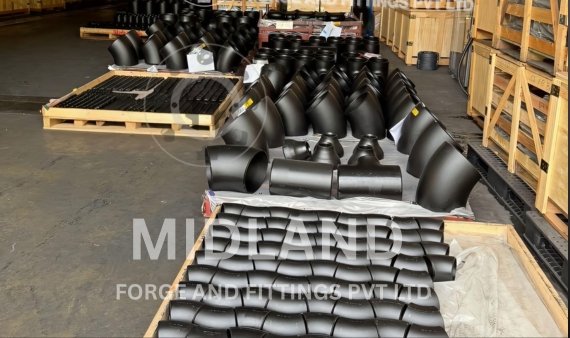
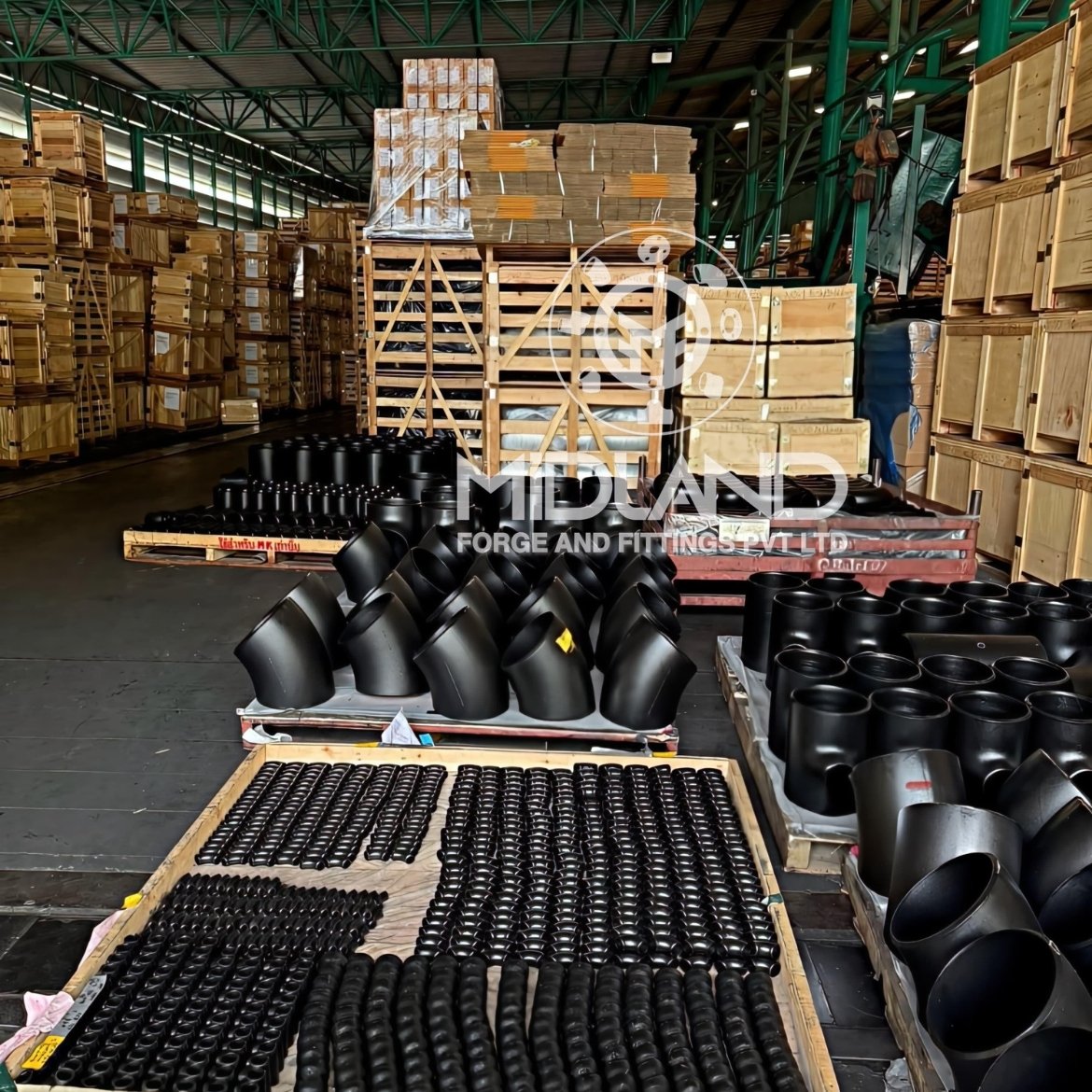
Different Types of Carbon Steel Buttweld Pipe Fittings – Seamless & Welded
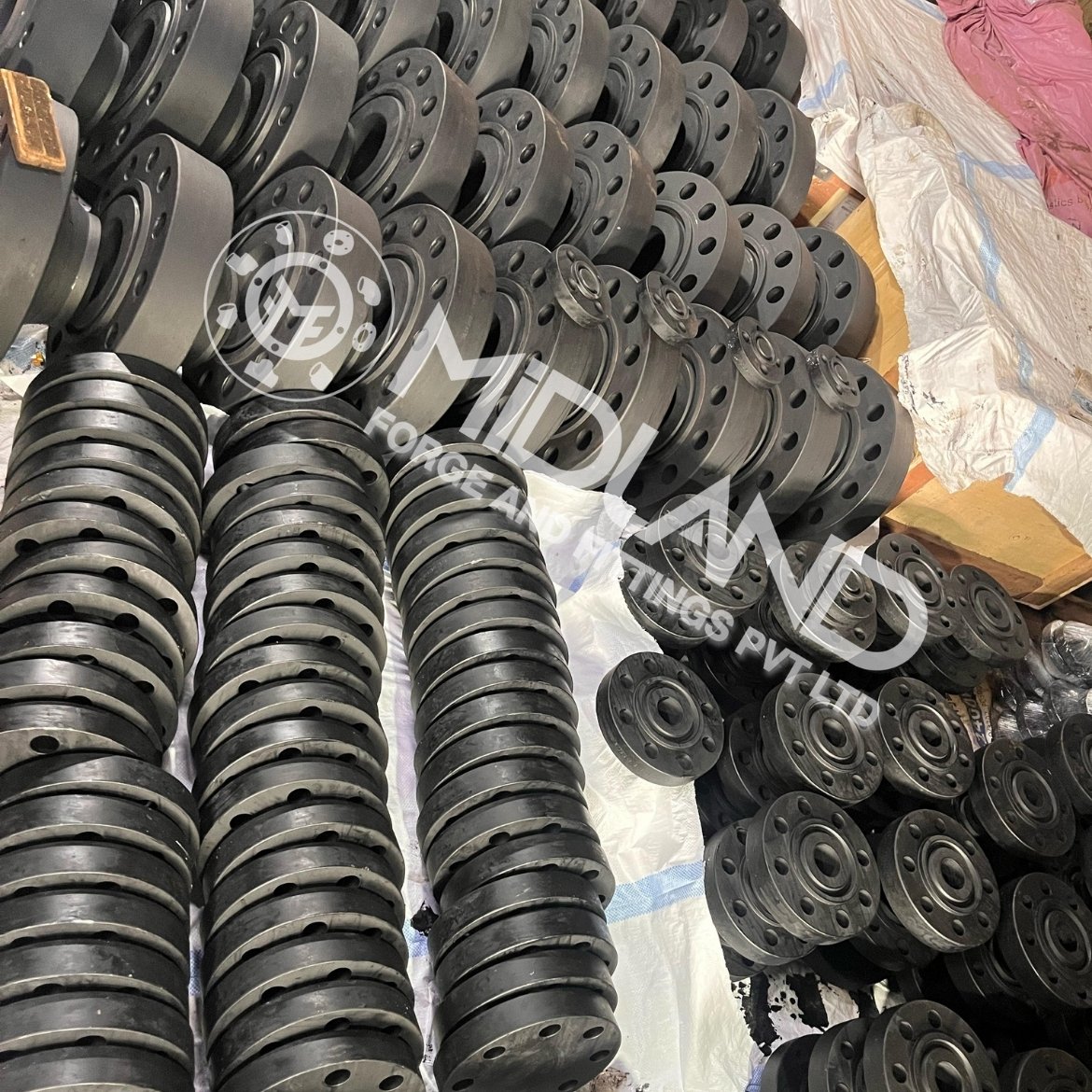
Carbon Steel Flanges – Industrial Piping Solutions with ANSI / ASME Compliance
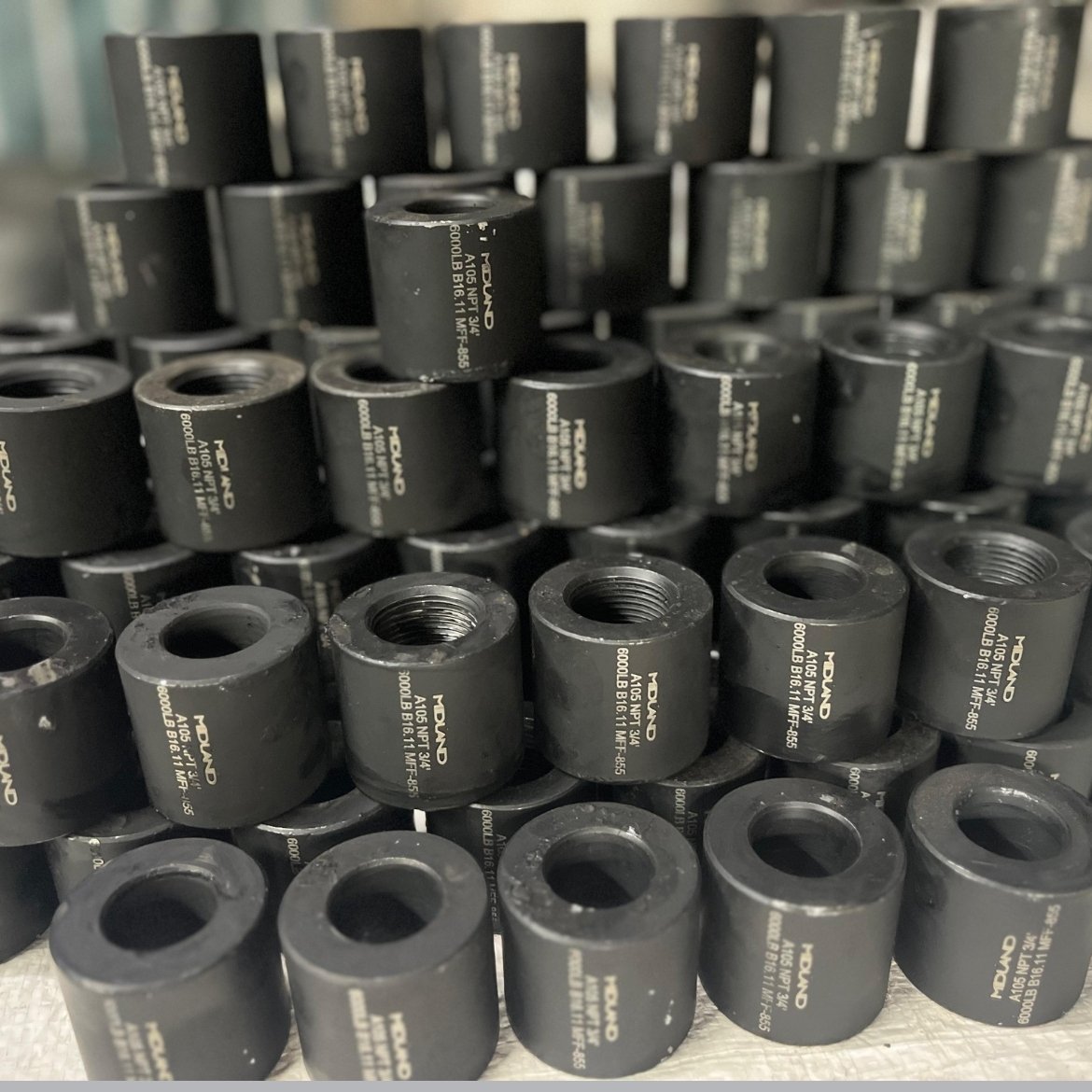
Carbon Steel Forged Fittings: Threaded, Socket Weld
How does the carbon equivalent (CE) value influence weldability of carbon steel fittings and flanges?
Carbon Equivalent (CE) is calculated using:
CE=C+Mn6+Cr+Mo+V5+Ni+Cu15CE = C + \frac{Mn}{6} + \frac{Cr + Mo + V}{5} + \frac{Ni + Cu}{15}CE=C+6Mn+5Cr+Mo+V+15Ni+CuSignificance:
CE > 0.45 → higher risk of cold cracking during welding.
CE ≤ 0.40 → excellent weldability without preheating.
Impact: Ensures selection of proper preheat, interpass temperature, and filler material for high-strength or thick fittings.
How does heat treatment affect the mechanical properties of carbon steel flanges and fittings?
Normalization (A105N, F1/F2):
Refines grain structure → increases toughness and uniformity.
Reduces residual stresses from forging or machining.
Quenching & Tempering (rare for carbon steel flanges):
Used in high-strength applications; increases tensile strength while retaining ductility.
Impact: Selecting the proper heat treatment ensures resistance to brittle fracture under fluctuating pressure and temperature conditions.
How are carbon steel fittings and flanges tested for quality and compliance?
Non-destructive Testing (NDT): Radiography (RT), Ultrasonic (UT), Magnetic Particle (MT), Dye Penetrant (PT).
Hydrostatic Testing: Pressure-tested to ensure integrity under operating conditions.
Mechanical Testing: Tensile, hardness, impact, and bend tests.
Chemical Testing: Spectrochemical analysis to confirm composition.
Impact: Ensures reliability, safety, and compliance with international codes.