
- Home
- Carbon Steel
- ASTM A234 WPB/WPC
ASTM A234 WPB/WPC
A234 WPB/WPC: Specifications | Grades & Standards | Equivalent Grades | Chemical Composition | Mechanical Properties | BW Fittings | FAQ
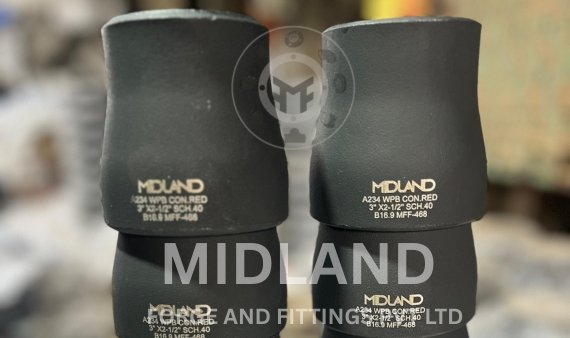
Global Supplier & Trusted Manufacturer of A234 WPB / WPC pipe fittings, Wrought carbon steel fittings including A234 Elbows, Tees, Reducers, Crosses, Caps – ASTM Certified, Serving USA, Germany, Italy, UAE, Saudi Arabia & More.
Best Export Prices: sales@midlandforgefittings.com
Midland Forge and Fittings Pvt. Ltd is a premier manufacturer, supplier, and exporter of high-quality Wrought carbon steel fittings. Established with a focus on precision engineering and industrial standards, the company specializes in ASTM A234 WPB / WPC grades. It offers a wide range of products, including elbows, tees, reducers, caps, and crosses for buttweld applications.
Our state-of-the-art manufacturing facility combines advanced forging and machining processes with strict quality control, ensuring that every product meets ASTM certification and international standards. We serve a global clientele, supplying durable and reliable CS piping solutions to industries such as oil & gas, petrochemical, and power generation, with exports reaching countries including the USA, Germany, Italy, the UAE, Saudi Arabia, Qatar, Oman, Kuwait, Singapore, and Malaysia.
ASTM A234 WPB is a high-quality carbon steel grade used for buttweld fittings in high-pressure and high-temperature piping systems. It is manufactured in forged or seamless forms, offering excellent mechanical strength, weldability, and dimensional accuracy. Its chemical composition and mechanical properties ensure durability and reliable performance in industrial applications.
ASTM A234 WPC is a weldable carbon steel grade with additional corrosion resistance, designed for piping systems operating under moderate pressure and temperature. It is commonly used in buttweld fittings. WPC grade provides enhanced resistance to weld decay and cracking, maintaining structural integrity over prolonged service life. Its mechanical properties and chemical composition make it suitable for industrial pipelines.
ASTM A234 WPB Pipe Fittings Specifications
Size Range – (Buttweld)
Pressure Rating/ Wall Thickness
Applications
ASTM / ASME - Grades
Types
Quality Certifications
Dimensional Standards
Forms
Surface Finish
A234 WPB BW LR Elbow – Grades & Standards
| Carbon Steel Grade | UNS No. | Applicable Standards | Typical Products | Key Features |
|---|---|---|---|---|
| ASTM A234 WPB | K02600 | ASTM A234, ASME B16.9, B16.11 | Buttweld Fittings, Elbows, Tees, Reducers | Good weldability, moderate corrosion resistance, general-purpose piping |
Explore Carbon Steel
Request for an Immediate Offer?
We will reply you in 2 hours during support time!
Conctact Now!Explore All Products
Carbon Steel A234 WPB Buttweld Fittings Equivalent Grades
| Standard / Specification | Equivalent Grade / Material | Region / Usage |
|---|---|---|
| ASTM A234 WPB | A234 WPB | USA / International |
| EN / DIN | 1.0619, 16Mo3 | Europe / Germany |
| JIS | STPG 370, STPG 410 | Japan |
| GOST / Russian | 12KhN3A, 20 | Russia / CIS countries |
| BS / British | 43A, 43B | UK |
| API | API 5L Grade B | International (Oil & Gas) |
| ISO | ISO 3183 Grade B | International |
Wrought carbon steel fittings - Chemical Composition
| Grade | C (%) | Mn (%) | P (%) | S (%) | Si (%) | Other Elements |
|---|---|---|---|---|---|---|
| A234 WPB | 0.30 max | 1.05 max | 0.035 max | 0.035 max | 0.10–0.35 | – |
| A234 WPC | 0.25–0.30 | 1.00–1.20 | 0.035 max | 0.035 max | 0.10–0.35 | Additional Cu, Ni, Cr for corrosion resistance |
A234 WPC Elbow, Tee, Cross - Mechanical Properties
| Grade | Tensile Strength (MPa) | Yield Strength (MPa) | Elongation (%) | Hardness (HB) |
|---|---|---|---|---|
| A234 WPB | 485–620 | ≥205 | 20–30 | 163–217 |
| A234 WPC | 485–620 | ≥205 | 20–30 | 163–217 |
Different Types of ASTM A234 WPB/WPC Buttweld Fittings – Seamless & Welded
How does ASTM A234 WPB / WPC maintain mechanical strength after welding?
Uniform Metallurgical Structure: Both WPB and WPC are manufactured using forged or seamless processes, ensuring a homogeneous grain structure. This minimizes weak points in the material, especially in the heat-affected zone (HAZ) during welding.
Retention of Tensile Strength: WPB fittings maintain a tensile strength of 485–620 MPa and yield strength ≥205 MPa even after high-temperature welding, making them ideal for high-pressure pipelines.
WPC Corrosion Protection: WPC contains minor alloying elements like Cu, Ni, and Cr that protect against weld decay and corrosion while maintaining mechanical performance.
Dimensional Stability: Post-welding, the fittings retain precise dimensions, which are critical for leak-free assembly in industrial piping systems.
Why is WPB preferred over other carbon steel grades for high-pressure applications?
Optimized Carbon Content: WPB has low carbon content (≤0.30%), ensuring excellent weldability without compromising strength or toughness.
High Pressure Endurance: The grade provides uniform tensile and yield strength, capable of withstanding internal pressure fluctuations, thermal expansion, and mechanical stress.
Versatile Application: WPB is used for elbows, tees, reducers, caps, crosses, making it the preferred choice for critical industrial pipelines.
Durability: Its mechanical properties and forging process provide resistance to fatigue, cracking, and deformation under long-term service conditions.
What distinguishes WPB/WPC from other ASTM carbon steel grades?
WPB Advantage: Optimized for high-pressure and high-temperature pipelines, offering strength, ductility, and weldability superior to standard A106 or A105 steels.
WPC Advantage: Adds corrosion resistance through minor alloying without compromising mechanical properties, unlike regular carbon steel grades.
Global Compatibility: Both grades are compatible with EN/DIN, JIS, GOST, and ISO equivalents, allowing international use in oil & gas, chemical, and petrochemical pipelines.
Reliability: Maintains strength and structural integrity post-welding, with resistance to fatigue, thermal expansion, and chemical exposure.