
- Home
- Alloy Steel
- ASTM A182 F1 / F5 / F9 / F11 / F22 / F91
ASTM A182 F1 / F5 / F9 / F11 / F22 / F91
A182 F1/F5/F9/F11/F22/F91: Specifications | Grades & Standards | Equivalent Grades | Chemical Composition | Mechanical Properties | Forged Fittings | Flanges
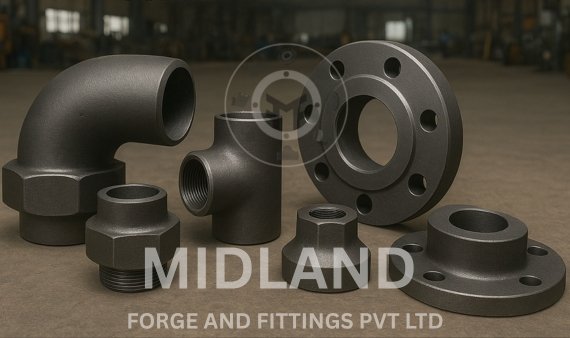
ASTM A182 F1/F5/F9/F11/F22/F91 flanges and forged fittings range, including weld neck, slip-on, and blind flanges, along with elbows, tees, reducers, caps, and bends, perfect for Cr-Mo high-pressure, high-temperature piping in power, petrochemical, and refinery industries.
Best Export Prices: sales@midlandforgefittings.com
Midland Forge and Fittings Pvt. Ltd. is a trusted manufacturer and supplier of premium A182 F1/F5/F9/F11/F22/F91 flanges, forged fittings, and piping solutions. With advanced manufacturing facilities and a skilled team, we deliver high-quality, durable products for power plants, petrochemical, refinery, and high-pressure piping industries. Our streamlined workflow ensures precision, quality, and timely delivery, making us a reliable partner for diverse industrial applications.
We pride ourselves on engineering excellence and quality assurance. Our end-to-end workflow—from sourcing premium raw materials to precision forging, machining, and rigorous quality testing—ensures every flange and fitting meets international standards. Backed by experienced professionals and modern infrastructure.
ASTM A182 F1, F5, F9, F11, F22, and F91 forged fittings are manufactured from high-strength Cr-Mo alloy steel, offering excellent tensile strength, creep resistance, and durability for high-pressure, high-temperature applications. These fittings are ideal for piping systems in power plants, petrochemical, and refinery industries.
F1, F5, F9, F11, F22, and F91 fittings are produced using hot forging followed by precision machining to maintain tight dimensional tolerances. Each fitting undergoes strict quality control, including chemical composition verification, mechanical testing (tensile, hardness, impact), and non-destructive testing (ultrasonic or radiography) to ensure full compliance with ASTM A182 standards.
ASTM A182 F1, F5, F9, F11, F22, and F91 flanges are forged from Cr-Mo alloy steel to withstand extreme pressures and temperatures. Available in weld neck, slip-on, blind, threaded, and lap joint types, these flanges are engineered for seamless integration into high-pressure piping systems using F1, F5, F9, F11, F22, and F91 materials.
Flanges in grades F1, F5, F9, F11, F22, and F91 are heat-treated and precision-machined to meet stringent dimensional and surface finish requirements. They undergo mechanical testing, hardness checks, and non-destructive inspections, ensuring full compliance with ASTM A182 standards and reliability for critical industrial applications.
At Midland Forge and Fittings Pvt. Ltd., quality, reliability, and customer satisfaction are at the core of everything we do. From meticulous raw material selection to precision machining and stringent quality inspection, our end-to-end workflow guarantees products that meet international standards. Serving power plants, petrochemical units, and refineries, we provide durable and performance-driven flanges and fittings for critical piping applications.
ASTM A182 F1 Forged Fittings Specifications
Size Range
Presure Class
Applications
ASTM / ASME - Grades
End Connections
Manufacturing Process
Dimensional Standards
Product Form
Connection Types (Fittings)
Alloy Steel A182 F5 Flanges – Grades & Standards
| Grade | ASTM Standard | Material Type | Application / Notes |
|---|---|---|---|
| F1 | ASTM A182 | Cr-Mo Alloy Steel Forged Fittings & Flanges | Suitable for moderate-temperature service, power plant piping, petrochemical and refinery lines. |
| F5 | ASTM A182 | Cr-Mo Alloy Steel Forged Fittings & Flanges | Designed for high-temperature service, including boilers, superheaters, and industrial piping. |
| F9 | ASTM A182 | Cr-Mo Alloy Steel Forged Fittings & Flanges | High-pressure and high-temperature applications in power generation and refinery piping systems. |
| F11 | ASTM A182 | Cr-Mo Alloy Steel Forged Fittings & Flanges | For elevated temperature and pressure service, used in power plants, petrochemical, and chemical process lines. |
| F22 | ASTM A182 | Cr-Mo Alloy Steel Forged Fittings & Flanges | Suitable for very high-temperature and pressure conditions in boilers, superheaters, and high-pressure piping networks. |
| F91 | ASTM A182 | Cr-Mo-V Alloy Steel Forged Fittings & Flanges | Designed for ultra-high-temperature and high-pressure applications, commonly used in advanced power plants and critical refinery piping systems. |
Request for an Immediate Offer?
We will reply you in 2 hours during support time!
Conctact Now!Explore All Products
ASTM A182 F9 Alloy Steel Flanges - Equivalent Grades
| ASTM Grade | UNS No. | EN (DIN) | JIS | GOST | BS | AFNOR |
|---|---|---|---|---|---|---|
| F1 | K11501 | 13CrMo4-5 | SCMV2 | 15CrMo | 13CrMo4-5 | Z2CND5 |
| F5 | K11545 | 11CrMo9-10 | SCM9V | 12CrMo9-10 | 11CrMo9-10 | Z12CDV9-10 |
| F9 | K91541 | 15CrMoG | SCMT9 | 15CrMo | 15CrMo | Z10CDV9 |
| F11 | K91524 | 12Cr1MoV | SCV11 | 12Cr1MoV | 12Cr1MoV | Z12CDV12-12 |
| F22 | K91516 | 13CrMo4-5 | SCMV4 | 13CrMo4-5 | 13CrMo4-5 | Z2CND5-5 |
| F91 | K91560 | X10CrMoVNb9-1 | – | 12Ch18N10T | 15CDV9 | – |
Alloy Steel ASTM A182 F22 Threaded Fittings - Chemical Composition
| ASTM Grade |
C (%) |
Mn (%) |
P (%) |
S (%) |
Si (%) |
Cr (%) |
Mo (%) |
V (%) |
Nb (%) |
Ni (%) |
|---|---|---|---|---|---|---|---|---|---|---|
| F1 | 0.10 max | 0.60 | 0.035 max | 0.035 max | 0.40 | 0.50-0.65 | 0.08-0.15 | – | – | – |
| F5 | 0.10 max | 0.40-0.70 | 0.035 max | 0.035 max | 0.40 | 0.50-0.75 | 0.45-0.65 | – | – | – |
| F9 | 0.08-0.15 | 0.40-0.70 | 0.030 max | 0.030 max | 0.40 | 1.00-1.25 | 0.40-0.55 | – | – | – |
| F11 | 0.08-0.15 | 0.30-0.60 | 0.035 max | 0.035 max | 0.40 | 1.00-1.25 | 0.45-0.65 | – | – | – |
| F22 | 0.08-0.15 | 0.30-0.60 | 0.035 max | 0.035 max | 0.40 | 2.00-2.50 | 1.00 | – | – | – |
| F91 | 0.08-0.12 | 0.30-0.50 | 0.020 max | 0.010 max | 0.20-0.50 | 8.50-9.50 | 0.85-1.05 | 0.18-0.25 | 0.06-0.12 | 0.20-0.50 |
F91 Chrome Moly Alloy Steel Flanges - Mechanical Properties
| ASTM Grade |
Tensile Strength (MPa) |
Yield Strength (MPa) |
Elongation (%) |
Hardness (HB) |
Impact Test (J) |
Remarks |
|---|---|---|---|---|---|---|
| F1 | 415-585 | 205-310 | 22 min | 150-200 | 27 min @ RT | Suitable for moderate-temp service |
| F5 | 485-620 | 205-350 | 22 min | 180-220 | 27 min @ RT | High-temp Cr-Mo alloy steel |
| F9 | 485-620 | 205-350 | 22 min | 190-230 | 27 min @ RT | High-pressure and high-temp applications |
| F11 | 485-620 | 205-350 | 22 min | 190-230 | 27 min @ RT | Elevated temp & pressure applications |
| F22 | 485-620 | 205-350 | 20 min | 200-240 | 27 min @ RT | Very high-temp & |
Cr-Mo Alloy Steel ASTM A182 F1–F91 Forged Fittings – Available in Threaded and Socket Weld
Alloy Steel Flanges ASTM A182 F1 to F91
How does alloy design affect weldability and fabrication of A182 F-series components?
The weldability of A182 materials depends heavily on their carbon and alloy content:
Lower grades like F1 and F11 exhibit excellent weldability with minimal preheat requirements (150–200°C).
F5, F9, and F22 require controlled preheat (200–300°C) and post-weld heat treatment (PWHT) to prevent hydrogen-induced cracking and restore toughness.
F91 demands strict weld procedures using compatible filler metals (e.g., ER90S-B9 or E9015-B9) with interpass control (≤ 250°C) and tempering at 760°C post-weld.
Microstructural mismatches between weld metal and base metal can cause Type IV creep failures at the heat-affected zone if procedures are not followed.
Therefore, precise PWHT cycles and ferrite number control are crucial for ensuring long-term reliability in critical pressure boundary applications.
What role does creep strength play in the selection of A182 F91 over lower grades?
Creep strength defines a material’s ability to withstand long-term stress at high temperatures without excessive deformation.
F1–F22 alloys possess moderate creep rupture strengths suitable for service up to 550°C.
F91, however, demonstrates twice the rupture strength at 600°C due to its Cr-Mo-V-Nb chemistry and tempered martensitic microstructure.
The presence of vanadium and niobium forms stable MC-type carbides, which pin grain boundaries and retard dislocation movement under stress.
This results in exceptional creep-rupture resistance (≥ 100 MPa at 600°C for 100,000 hours), making F91 the material of choice for supercritical boilers, reheater tubes, and advanced power plant piping where long-term dimensional stability and stress resistance are critical.
What differentiates the microstructural stability among F1, F5, F9, F11, F22, and F91 after heat treatment?
Each grade has a distinct microstructure that defines its performance:
F1 (0.5Cr–0.5Mo): Ferrite–Pearlite matrix; soft, ductile, and machinable but limited to moderate temperatures.
F5 (5Cr–0.5Mo): Ferritic–Martensitic structure after normalization and tempering; good oxidation resistance.
F9 (9Cr–1Mo): Fully tempered martensitic structure; provides superior strength and creep resistance at 600°C+.
F11/F22 (1.25Cr–0.5Mo & 2.25Cr–1Mo): Bainitic–martensitic structure; optimized for long-term service under thermal cycling.
F91 (9Cr–1Mo–V–Nb): Tempered martensite with vanadium and niobium carbides finely dispersed, providing outstanding microstructural stability and resistance to grain coarsening even after 100,000 hours at 600°C.
This microstructural evolution ensures dimensional integrity, minimal embrittlement, and prolonged component life in high-temperature environments.