
- Home
- Carbon Steel
- ASTM A516 Gr.70
ASTM A516 Gr.70
A516 Gr.70: Specifications | Grades & Standards | Equivalent Grades | Chemical Composition | Mechanical Properties | FAQ
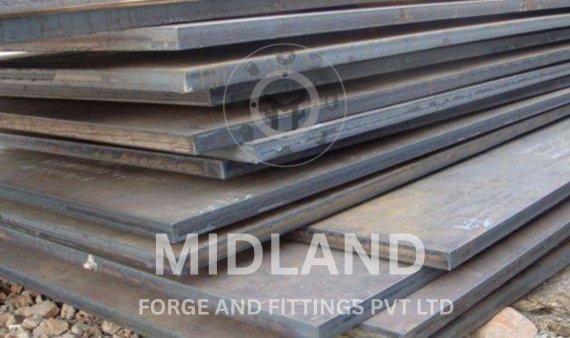
Trusted Manufacturer & Exporter of Carbon steel pressure vessel plate, ASTM A516 Grade 70 plate, ASTM A516 Grade 70 sheet, A516 Gr.70 normalized plate, A516 Gr 70 plate for boiler / heat exchanger serving USA, Germany, Italy, UAE & Middle East.
Best Export Prices: sales@midlandforgefittings.com
Midland Forge and Fittings Pvt. Ltd. is a trusted name in the manufacturing and supplying of ASTM A516 Grade 70 pressure vessel plates, known for precision engineering and uncompromising quality.
With advanced forging and heat-treatment facilities, we deliver plates that meet the most demanding mechanical and dimensional ASTM A516 / ASME SA516 standards. Our materials undergo rigorous testing and quality assurance to ensure exceptional strength, ductility, and notch toughness—making them ideal for boilers, pressure vessels, and heat exchanger fabrication.
ASTM A516 Grade 70 plates are produced through controlled rolling and precise heat treatment processes to achieve superior metallurgical stability, strength, and dimensional uniformity. The steel exhibits excellent resistance to hydrogen-induced cracking (HIC) and stress corrosion, making it ideal for environments containing pressurized gases, chemical vapors, and corrosive fluids. Each plate is tested according to ASTM A578 or A435 ultrasonic inspection standards to ensure complete internal soundness and defect-free quality. The material’s fine-grained ferrite–pearlite structure contributes to outstanding toughness, especially under low or sub-zero temperature conditions, ensuring dependable performance under thermal cycling and varying stress levels.
When post-weld heat treatment (PWHT) is properly applied, ASTM A516 Grade 70 demonstrates remarkable creep resistance, fatigue strength, and structural stability, making it suitable for long-term service in high-pressure and high-temperature vessels. The specification allows for additional quality checks such as impact testing, hardness measurement, and macro examination, as required by the design code. All plates comply with ASME Section VIII Division 1 and 2 requirements, confirming their reliability for the fabrication of critical pressure containment and boiler systems used across the petrochemical, power, and process industries.
We take pride in offering custom-cut ASTM A516 Gr.70 plates in various thicknesses, widths, and lengths to suit specific project requirements. Our in-house expertise, adherence to international standards, and commitment to timely delivery have made us a preferred partner for major industries across oil & gas, petrochemical, power generation, and process equipment sectors. We don’t just supply steel—we provide reliability, consistency, and long-term performance in every plate we produce.
Pressure vessel steel plate Specifications
Thickness Range
Applications
Plate Type
ASTM / ASME - Grades
Product Form
Width / Length Range
Up to 12000 mm
Dimensional Standards
Process
Manufacturing Type
ASTM A516 Grade 70 sheet – Grades & Standards
| Carbon Steel Grade | UNS No. | Applicable Standards | Typical Products |
|---|---|---|---|
| ASTM A516 Grade 70 | K02700 | ASTM A516 / ASME SA516 | Plates, Sheets, Cut-to-size Plates, Fabricated Vessels |
Explore Carbon Steel
Request for an Immediate Offer?
We will reply you in 2 hours during support time!
Conctact Now!Explore All Products
A516 Gr.70 normalized plate Equivalent Grades
| Standard | Grade Equivalent |
|---|---|
| EN | P355GH |
| DIN | 17Mn4 |
| BS | 1501-224-490A/B |
| JIS | SPV355 |
| AFNOR | A42CP |
| UNI | Fe510-1KW |
A516 Carbon steel pressure vessel plate - Chemical Composition
| Element | Grade 70 (Max %) |
|---|---|
| Carbon (C) | 0.27 |
| Manganese (Mn) | 0.85 – 1.20 |
| Phosphorus (P) | 0.035 max |
| Sulfur (S) | 0.035 max |
| Silicon (Si) | 0.13 – 0.45 |
| Copper (Cu) | 0.35 max |
| Nickel (Ni) | 0.25 max |
| Chromium (Cr) | 0.25 max |
| Molybdenum (Mo) | 0.08 max |
| Vanadium (V) | 0.02 max |
A516 Gr.70 steel plate - Mechanical Properties
| Property | Requirement |
|---|---|
| Tensile Strength | 485 – 620 MPa (70 – 90 ksi) |
| Yield Strength (min) | 260 MPa (38 ksi) |
| Elongation (min, in 200mm) | 17% |
| Elongation (min, in 50mm) | 21% |
| Impact Test | Required for certain thicknesses or low-temperature service |
What is ASTM A516 Grade 70 used for?
ASTM A516 Grade 70 is a high-strength carbon-manganese steel plate primarily designed for pressure-containing applications.
It is widely used in the manufacture of boilers, pressure vessels, heat exchangers, and storage tanks where moderate to low-temperature service is required.
The material’s excellent combination of tensile strength, yield strength, and notch toughness ensures structural integrity under pressure and thermal cycling.
Its uniform metallurgical properties make it suitable for critical applications in oil & gas, petrochemical, power generation, and chemical processing industries.
Is A516 Gr.70 weldable?
Yes, ASTM A516 Grade 70 exhibits excellent weldability due to its fine-grained, killed steel structure, which minimizes the risk of cracking during welding.
It is compatible with common welding processes, including:
SMAW (Shielded Metal Arc Welding)
GMAW (Gas Metal Arc Welding / MIG)
GTAW (Gas Tungsten Arc Welding / TIG)
When welding thicker sections, proper preheat and post-weld heat treatment (PWHT) is recommended to maintain toughness and avoid residual stresses.
Its chemical composition, with controlled levels of carbon, phosphorus, sulfur, and other alloying elements, supports strong, ductile weld joints suitable for pressure vessel construction.
What is the difference between A516 Grade 70 and Grade 60?
The primary difference lies in mechanical properties:
Grade 70 has a higher minimum tensile strength (485–620 MPa) and yield strength (260 MPa) compared to Grade 60.
This higher strength allows Grade 70 to withstand higher internal pressures, making it suitable for more demanding service conditions.
Grade 60 is still used for moderate pressure applications, but Grade 70 is preferred when enhanced structural integrity and safety margins are required.
Both grades share similar chemical compositions and weldability, but Grade 70’s higher strength is achieved through slightly tighter control on alloying elements and heat treatment.