
- Home
- Stainless steel
Stainless steel
Stainless Steel: Specifications | Grades & Standards | Product Types | Equivalent Grades | Chemical Composition | Mechanical Properties | FAQ
Manufacturers, Suppliers & Exporters of Stainless Steel Buttweld Fittings, Forged Fittings & Flanges in Grades 304, 304L, 316, 316L, 310, 310s & 904L (ASTM A182 / A403) to the USA, Europe, Middle East & African Countriess
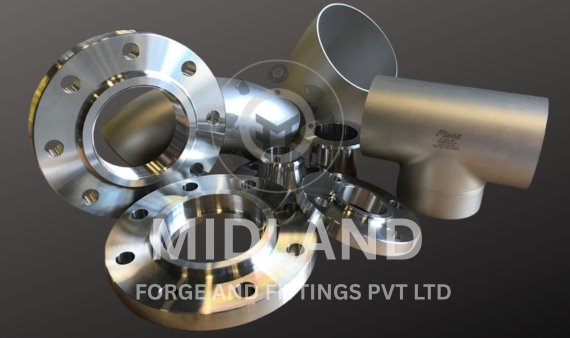
Best Export Prices: sales@midlandforgefittings.com
Midland Forge and Fittings Pvt. Ltd. is a leading manufacturer, supplier, and exporter of premium piping components, specializing in Stainless Steel Buttweld Fittings, Forged Fittings, and Flanges. With decades of experience, the company combines modern engineering practices with precision manufacturing to deliver products that meet global quality standards.
We take pride in our state-of-the-art manufacturing facility, which is equipped with advanced forging, CNC machining, and inspection equipment to ensure the high accuracy, dimensional integrity, and long-term reliability of every component.
Our organizational structure is designed to maintain efficiency, quality, and innovation at every production stage. From the procurement of premium raw materials to in-house forging, heat treatment, and rigorous quality testing, each department works seamlessly under the guidance of skilled engineers and quality professionals.
Midland adheres strictly to international standards like ASTM, ASME, DIN, and JIS, making our products highly trusted across industries, including oil & gas, petrochemical, power generation, marine, and construction worldwide. Our commitment to excellence ensures timely delivery, customized solutions, and full customer satisfaction for clients across the globe.
Stainless steel is an alloy of iron, chromium, and other elements such as nickel and molybdenum, engineered for superior corrosion resistance, durability, and high-temperature performance. The addition of chromium (minimum 10.5%) forms a thin, self-healing oxide layer on the surface, protecting it from oxidation and chemical attack. Common stainless steel grades used in industrial applications include 304, 304L, 316, 316L, and 310, each offering unique combinations of strength, corrosion resistance, and temperature tolerance. These grades are widely used in piping systems, fittings, flanges, and other critical components where longevity and reliability are essential.
Mechanical properties of stainless steel, including tensile strength, yield strength, elongation, and hardness, are highly dependent on the grade and processing method. 304 and 304L are widely used for general-purpose applications due to their excellent corrosion resistance and good formability, while 316 and 316L include molybdenum for enhanced resistance to chlorides and acidic environments. 310 stainless steel is specifically engineered for high-temperature applications, capable of withstanding continuous service at elevated temperatures up to 1100°C. Proper selection of grade ensures optimal performance in diverse industrial conditions.
Stainless steel products must comply with international standards such as ASTM A182, A403, A240, and ASME B16.9/B16.11 for buttweld and forged components. These standards define the chemical composition, mechanical properties, dimensions, and testing procedures to ensure uniformity, safety, and reliability in service. Additionally, processes such as hot forging, heat treatment, ultrasonic testing, and positive material identification (PMI) guarantee that stainless steel components meet the rigorous demands of oil & gas, petrochemical, marine, and power industries. With the right combination of material grade, processing, and quality control, stainless steel components deliver exceptional performance, corrosion resistance, and long-term service life.
Stainless steel Flange Specifications
Size Range – (Buttweld, Forged, Flange)
Pressure Rating/ Wall Thickness
Applications
ASTM / ASME
Grades
Quality Certifications
Dimensional Standards
Forms
Surface Finish
Stainles Steel Pipe Fittings – Grades & Standards
| Stainless Steel Grade | UNS No. | Applicable Standards | Typical Products | Key Features |
|---|---|---|---|---|
| 304 / 304L | S30400 / S30403 | ASTM A182, A403, A240, ASME B16.9, B16.11, B16.5, MSS-SP-43 |
Buttweld Fittings, Forged Fittings, Flanges |
Excellent corrosion resistance, general-purpose |
| 304H | S30409 | ASTM A182, A403, ASME B16.9/B16.11 |
Buttweld & Forged Fittings | High-temperature grade |
| 316 / 316L | S31600 / S31603 | ASTM A182, A403, A240, ASME B16.9, B16.11, B16.5, MSS-SP-43 |
Buttweld Fittings, Forged Fittings, Flanges |
High corrosion resistance |
| 316Ti | S31635 | ASTM A182, A403, ASME B16.9/B16.11 |
Buttweld & Forged Fittings | Titanium-stabilized, better corrosion & creep resistance |
| 310 / 310S | S31000 / S31008 | ASTM A182, A403, ASME B16.9/B16.11 |
Buttweld Forged Fittings, Flanges | High-temperature resistance |
| 321 / 321H | S32100 / S32109 | ASTM A182, A403, ASME B16.9/B16.11 |
Buttweld & Forged Fittings | Titanium-stabilized at high temperatures |
| 347 / 347H | S34700 / S34709 | ASTM A182, A403, ASME B16.9/B16.11 |
Buttweld & Forged Fittings | Niobium-stabilized, ideal for heat exchangers |
| 904L | N08904 | ASTM A182, A240, ASME B16.5 |
Flanges, Fittings | Super austenitic, excellent resistance to strong acids |
Request for an Immediate Offer?
We will reply you in 2 hours during support time!
Conctact Now!Explore All Products
Stainless Steel Products
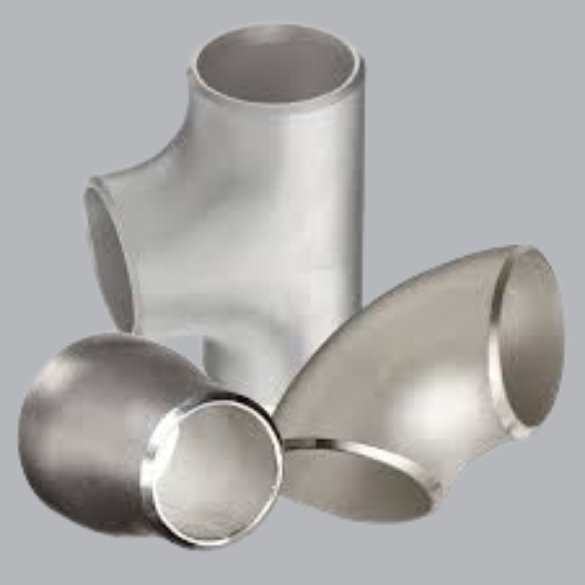
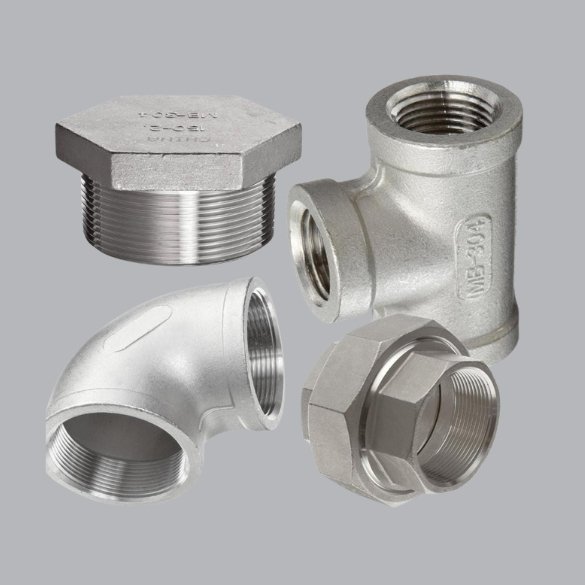
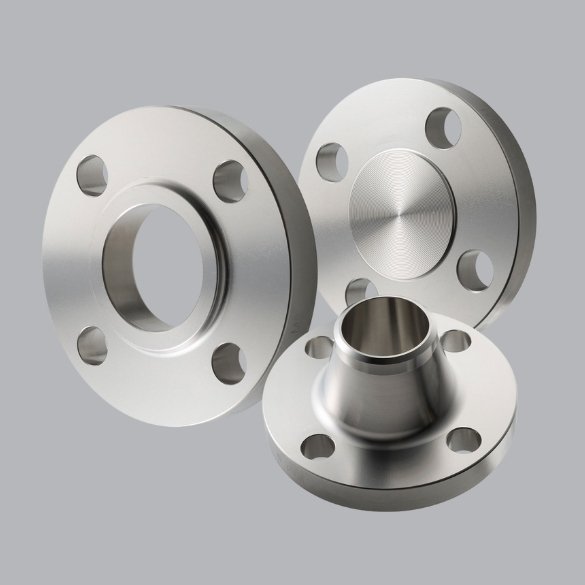
Stainless Steel Socket weld Fittings Equivalent Grades – ASTM, ASME, DIN, JIS & UNS
| Grade | UNS | ASTM | EN (DIN) | JIS | GOST | BS | AFNOR |
|---|---|---|---|---|---|---|---|
| 304 | S30400 | A240 / A276 | 1.4301 (X5CrNi18-10) | SUS304 | 08Х18Н10 (08X18H10) | 304S15 | Z6CN18-09 |
| 304L | S30403 | A240 / A276 | 1.4306 (X2CrNi18-9) | SUS304L | 03Х18Н11 (03X18H11) | 304S12 | Z2CN18-10 |
| 316 | S31600 | A240 / A276 | 1.4401 (X5CrNiMo17-12-2) | SUS316 | 08Х17Н13М2 (08X17H13M2) | 316S31 | Z6CND17-11 |
| 316L | S31603 | A240 / A276 | 1.4404 (X2CrNiMo17-12-2) | SUS316L | 03Х17Н14М3 (03X17H14M3) | 316S11 | Z2CND17-12 |
| 321 | S32100 | A240 / A276 | 1.4541 (X6CrNiTi18-10) | SUS321 | 08Х18Н10Т (08X18H10T) | 321S31 | Z6CNT18-10 |
| 347 | S34700 | A240 / A276 | 1.4550 (X6CrNiNb18-10) | SUS347 | 08Х18Н12Б (08X18H12B) | 347S31 | Z6CNNb18-10 |
| 310 | S31000 | A240 / A276 | 1.4845 (X12CrNi25-20) | SUS310S | 20Х23Н18 (20X23H18) | 310S24 | Z12CN25-20 |
| 904L | N08904 | A240 / A276 | 1.4539 (X1NiCrMoCu25-20-5) | SUS890L | – | – | Z2NCDU25-20 |
| 410 | S41000 | A240 / A276 | 1.4006 (X12Cr13) | SUS410 | 12Х13 (12X13) | 410S21 | Z12C13 |
| 430 | S43000 | A240 / A276 | 1.4016 (X6Cr17) | SUS430 | 12Х17 (12X17) | 430S17 | Z8C17 |
Chemical Composition of Stainless Steel Buttweld Fittings Grades – 304, 316, 310, 321, 347, 904L
| Grade | C (%) | Cr (%) | Ni (%) | Mo (%) | Mn (%) | Si (%) | P (%) | S (%) | N (%) | Others |
|---|---|---|---|---|---|---|---|---|---|---|
| 304 | ≤ 0.08 | 18.0 – 20.0 | 8.0 – 10.5 | – | ≤ 2.00 | ≤ 0.75 | ≤ 0.045 | ≤ 0.03 | – | – |
| 304L | ≤ 0.03 | 18.0 – 20.0 | 8.0 – 12.0 | – | ≤ 2.00 | ≤ 0.75 | ≤ 0.045 | ≤ 0.03 | – | – |
| 316 | ≤ 0.08 | 16.0 – 18.0 | 10.0 – 14.0 | 2.0 – 3.0 | ≤ 2.00 | ≤ 0.75 | ≤ 0.045 | ≤ 0.03 | – | – |
| 316L | ≤ 0.03 | 16.0 – 18.0 | 10.0 – 14.0 | 2.0 – 3.0 | ≤ 2.00 | ≤ 0.75 | ≤ 0.045 | ≤ 0.03 | – | – |
| 321 | ≤ 0.08 | 17.0 – 19.0 | 9.0 – 12.0 | – | ≤ 2.00 | ≤ 0.75 | ≤ 0.045 | ≤ 0.03 | – | Ti: 5x(C+N) min. |
| 347 | ≤ 0.08 | 17.0 – 19.0 | 9.0 – 13.0 | – | ≤ 2.00 | ≤ 0.75 | ≤ 0.045 | ≤ 0.03 | – | Nb: 10x(C+N) min. |
| 310 | ≤ 0.25 | 24.0 – 26.0 | 19.0 – 22.0 | – | ≤ 2.00 | ≤ 1.50 | ≤ 0.045 | ≤ 0.03 | – | – |
| 410 | ≤ 0.15 | 11.5 – 13.5 | ≤ 0.75 | – | ≤ 1.00 | ≤ 1.00 | ≤ 0.04 | ≤ 0.03 | – | – |
| 430 | ≤ 0.12 | 16.0 – 18.0 | ≤ 0.75 | – | ≤ 1.00 | ≤ 1.00 | ≤ 0.04 | ≤ 0.03 | – | – |
| 904L | ≤ 0.02 | 19.0 – 23.0 | 23.0 – 28.0 | 4.0 – 5.0 | ≤ 2.00 | ≤ 1.00 | ≤ 0.045 | ≤ 0.035 | – | Cu: 1.0 – 2.0 |
Mechanical Properties of Stainless Steel Forged Fittings
| Grade | Tensile Strength (MPa) | Yield Strength (MPa) | Elongation (%) | Hardness (HB) | Hardness (HRB) | Hardness (HRC) |
|---|---|---|---|---|---|---|
| 304 | 515 – 750 | ≥ 205 | ≥ 40 | ≤ 201 | ≤ 92 | ≤ 22 |
| 304L | 485 – 700 | ≥ 170 | ≥ 40 | ≤ 183 | ≤ 88 | ≤ 20 |
| 316 | 515 – 750 | ≥ 205 | ≥ 40 | ≤ 217 | ≤ 95 | ≤ 22 |
| 316L | 485 – 700 | ≥ 170 | ≥ 40 | ≤ 217 | ≤ 95 | ≤ 22 |
| 321 | 515 – 750 | ≥ 205 | ≥ 40 | ≤ 217 | ≤ 95 | ≤ 22 |
| 347 | 515 – 750 | ≥ 205 | ≥ 40 | ≤ 217 | ≤ 95 | ≤ 22 |
| 310 | 515 – 730 | ≥ 205 | ≥ 40 | ≤ 217 | ≤ 95 | ≤ 22 |
| 410 | 415 – 735 | ≥ 205 | ≥ 20 | ≤ 217 | ≤ 95 | ≤ 22 |
| 430 | 450 – 750 | ≥ 275 | ≥ 22 | ≤ 183 | ≤ 88 | ≤ 20 |
| 904L | 490 – 690 | ≥ 220 | ≥ 35 | ≤ 192 | ≤ 90 | ≤ 20 |
What Is Stainless Steel and How Is It Made?
What is Stainless Steel:
Stainless steel is a corrosion-resistant alloy of iron, containing at least 10.5% chromium by mass. Chromium forms a thin oxide layer on the surface, known as the passive layer, which prevents further corrosion and gives stainless steel its characteristic durability.
How Stainless Steel is made:
Stainless steel is produced by melting scrap metals and additives in an electric arc furnace (EAF) to create a molten alloy. Many grades contain up to 60% recycled steel, reducing cost and environmental impact.
Step 1: Carbon Control
Carbon content is reduced using Argon Oxygen Decarburization (AOD) or Vacuum Oxygen Decarburization (VOD) to prevent welding issues and ensure proper alloy characteristics.
Step 2: Homogenization
The molten steel is balanced and tested to ensure uniform composition and temperature before forming.
Step 3: Forming & Shaping
Molten steel is cast into blooms, billets, slabs, rods, or tubes, depending on the final product. Subsequent processes include:
Hot Rolling: Shapes steel at high temperatures.
Cold Rolling: Refines dimensions and finish below recrystallization temperature.
Annealing: Controlled heating and cooling to relieve stress and soften steel.
Step 4: Surface Treatment
Descaling or pickling removes surface impurities to enhance corrosion resistance.
Step 5: Cutting & Finishing
Steel is cut to size using mechanical or flame/plasma methods and finished to matte or mirror surfaces using grinding, polishing, or blasting.
The final products are prepared for delivery, ready for applications in Buttweld fittings, Forged fittings, Flanges, and other stainless steel components.
Why Stainless Steel is Preferred
High Corrosion Resistance
Stainless steel forms a passive chromium oxide layer on its surface, protecting it from rust, oxidation, and chemical attacks.
This makes it suitable for harsh environments such as marine, chemical, and acidic conditions.
Even if the surface is scratched, the protective layer self-heals, maintaining durability over time.
Heat and Wear Resistance
Certain grades, such as 310, 321, and 347, withstand high temperatures without losing strength or deforming.
Resistant to wear and abrasion, making it ideal for industrial machinery, pipelines, and structural components.
Maintains mechanical properties in high-stress or high-temperature applications.
Strength and Durability
Stainless steel has high tensile strength and toughness, making it reliable for structural and industrial applications.
Long-lasting with minimal maintenance, even in extreme operating conditions.
Duplex and super duplex grades combine high strength with superior corrosion resistance, ideal for offshore and chemical industries.
Hygienic and Easy to Maintain
Smooth surfaces prevent bacterial growth, making it perfect for food processing, pharmaceutical, and medical applications.
Requires minimal cleaning and maintenance, saving costs over time.
Resistant to staining, discoloration, and chemical damage, ensuring long-lasting aesthetic appeal.
Versatility in Fabrication and Finishing
It can be cut, welded, formed, and machined easily for customized applications.
Compatible with various finishing options: matte, brushed, mirror, or polished.
Suitable for complex products such as Buttweld fittings, Forged fittings, Flanges, and specialized industrial components.
Eco-friendly and Recyclable
Stainless steel is 100% recyclable, reducing environmental impact.
Recycled content can reach 60% or more, making it sustainable and cost-effective.
Classification of Stainless Steel:
-
Austenitic: 304, 316, 310; non-magnetic, excellent corrosion resistance.
-
Ferritic: 430, 446; magnetic, good corrosion resistance, lower ductility.
-
Martensitic: 410, 420; magnetic, higher hardness, moderate corrosion resistance.
-
Duplex: 2205, 2507; combination of austenitic and ferritic, high strength, excellent chloride resistance.
-
Precipitation Hardening (PH): 17-4 PH; heat-treatable, high strength, moderate corrosion resistance.